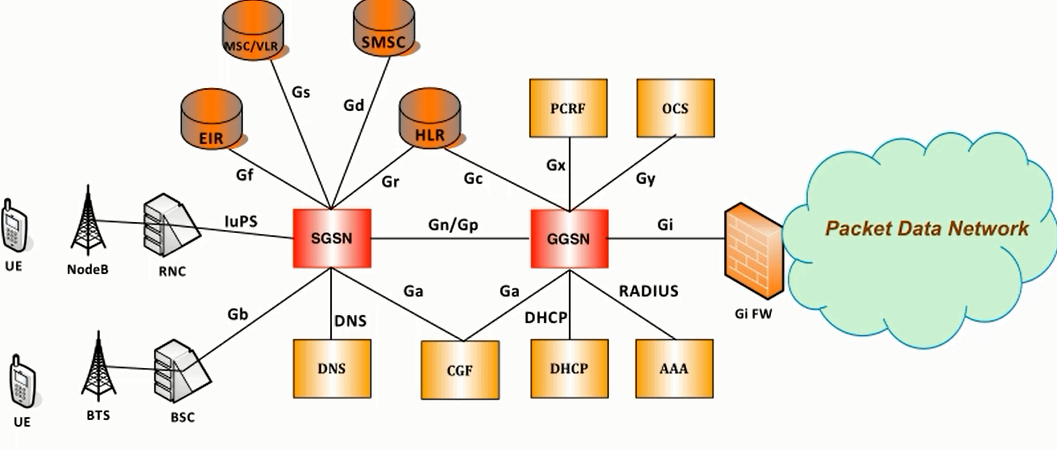
GGSN – Gateway GPSR support Node is the mobility anchor
point within the mobile packet core network. It provides connectivity to the
SGSN (Serving GPRS support Node) and PDN (Packet data network). Session state information
of the subscriber is always maintained at the GGSN. It also maintains the
necessary information required to route the user traffic towards the SGSN and
PDN.
GGSN is mostly located in the service provider network so
even if the subscriber is in roaming location or in the home network, he will
be connected to the GGSN located in the home network.
even if the subscriber is in roaming location or in the home network, he will
be connected to the GGSN located in the home network.
Key functions of GGSN
- Process PDP request from SGNSs in both home and foreign
PLMN network. After the subscriber is attached to the network, it will initiate
the PDP activate procedure. - Assign an IP address to the
subscriber – A subscriber could have maximum of 11 PDP context and secondary
PDP context. Each subscriber should have at least one primary PDP context in
order to access the services with the PRD network. The secondary PDP context
would create depending on the type of application the subscriber is accessing.
Depending upon the application, the bandwidth requirement may be higher, due to
which the secondary PDP context will be created. It depends on the type of
application as the application may need more bandwidth which was negotiated in
primary PDP context. For every primary PDP context, the GGSN will assign the IP
address since the secondary PDP context will be associated with the primary PDP
context and therefore GGSN will not assign an IP address to secondary PDP
context. - Negotiate QOS – For any given
subscriber session the GGSN will negotiate the QOS parameter with SGSN as a
part of PDP activation procedure and during any PDP modification procedure. - Dynamic Policy control – GGSN
has interface Gx towards the PCRF. This is used for policy control and charging
rule function. This function helps the GGSN to charge the subscriber as per the
QS policy. Depending upon the type of subscription, PCRF can negotiate various types
of QOS policies to the subscriber and install different charging rules. - Performs prepaid / postpaid
billing – using the Gy interface GGSN performs the prepaid billing, using the
OCS – Online charging server and performs the postpaid billing towards the
Charging gateway function. - GGSN also authenticates users
to perform the authentication using AAA, OCS and PCRF since all of these
maintain a database with the user subscription. - GGSN also provides secure VPN
tunnel connectivity of corporate subscriber towards the corporate PDN network.
Tunneling mechanism such as GRE, IPSEC, L2TP tunneling can be used for setting
up the tunneling interface on the Gi interface.
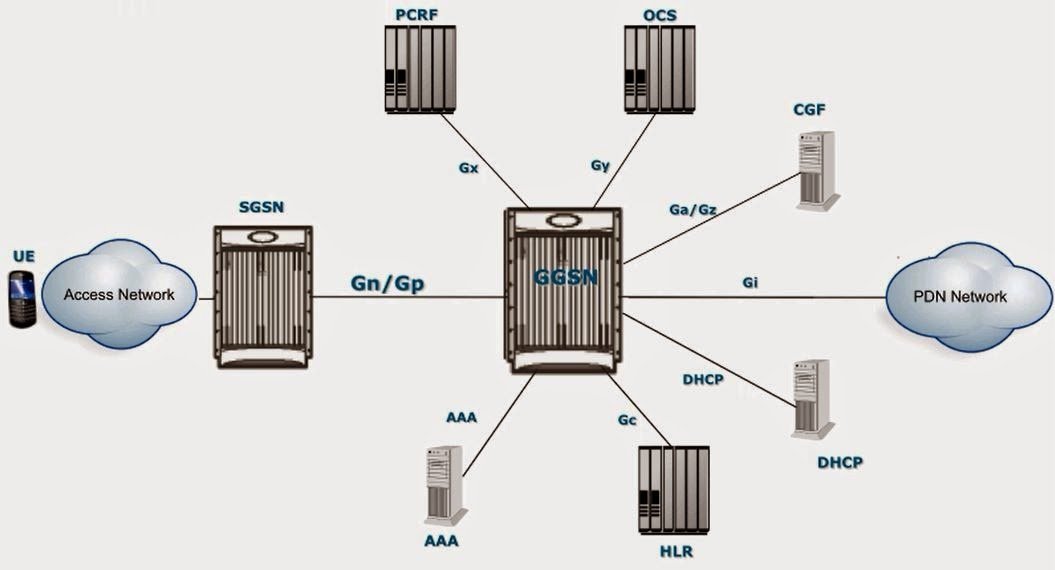
GGSN interface types –
- Gn/Gp interface – Used by GGSN to communicate with SGNSs within the
home/PLMN network. This interface is based on the GPRS tunneling protocol
(GTP). It uses the GP interface towards the SGSN within the foreign PLMN
network. This interface carries both Data and signaling plane traffic for a
subscriber PDP session. It uses GTP-C for control signaling and GTP-U for user
data traffic. - Gx Interface – It is used to communicate with te PCRF and its bases
on the diameter protocol. - Gy Interface – This interface is used between GGSN and OCS. It is
based on the diameter protocol used for prepaid billing. - Ga/Gz interface – As per the 3GPP standard, the Gz interface
between CTF (charging trigger function) and CDF (charging data function). The
CDF is a proxy between GGSN and CGF. The interface between the CDF and CGF is
known as Ga interface. - Gi Interface – This interface is between GGSN and PDN. It routes
the traffic towards the PDN for the services offered within PDN. This interface
carries both uplink and downlink subscriber data. - DHCP interface – This interface goes towards the DHCP server. The
GGSN can use this interface if external server is to be used for assigning IP
addresses to the subscribers. - GC interface – This interface goes towards HLR via GTP – MAP
protocol converter. It is used during network initiated PDP activation procedure. - AAA – This interface goes towards AAA server. It’s based on radius
protocol and used for authentication and accounting.