Question 1
In the
plan-and-execute architecture, what is the key benefit of separating planning
from execution?
- It reduces API costs
- It allows the agent to create an explicit
roadmap before acting, making complex tasks more manageable - It eliminates the need for tools
- It makes the agent respond faster
Ans – It allows the agent to create an explicit roadmap before acting, making
complex tasks more manageable
Question 2
What is the primary
role of the system prompt in an agent’s configuration?
- To reduce API costs by limiting token
usage - To define the agent’s identity, scope, and
behavioral guidelines - To specify which LLM model to use
- To store conversation history
Ans – To define the agent’s identity, scope, and
behavioral guidelines
Question 3
What is the primary
benefit of RAG (Retrieval-Augmented Generation) for an agent?
- It makes the agent respond faster
- It allows the agent to access current,
organization-specific knowledge - It reduces the cost of API calls
- It eliminates the need for working memory
Ans – It allows the agent to access current,
organization-specific knowledge
Question 4
What does the
“context window” represent in agent architecture?
- A graphical interface that displays the
agent’s current status and activity - The period of time during which the agent
remains active and responsive - The span of tokens the model can consider
at once when making decisions - A rule-based workflow that defines the
steps an agent follows sequentially
Ans – The span of tokens the model can consider at once when making
decisions
Question 5
Which of the following
is NOT a valid termination condition for an agent loop?
- The agent has completed the requested task
- The maximum iteration limit has been
reached - The agent’s confidence level drops below a
threshold - The agent receives approval to continue
Ans – The agent receives approval to continue
Question 6
An agent is
troubleshooting a network issue. Review this trace excerpt:
{
“iteration”: 3,
“thought”: “I should
check the router logs”,
“action”:
“get_router_logs”,
“observation”:
“Connection timed out”
}
{
“iteration”: 4,
“thought”: “I should
check the router logs”,
“action”:
“get_router_logs”,
“observation”:
“Connection timed out”
}
{
“iteration”: 5,
“thought”: “I should
check the router logs”,
“action”:
“get_router_logs”,
“observation”:
“Connection timed out”
}
What stuck state
pattern is this agent exhibiting, and what mechanism would help prevent it?
- Oscillation – implement fallback
strategies - Loop – implement iteration limits and
action history tracking - Dead end – add more tools to the agent
- Hallucination – improve tool descriptions
Ans – Dead end – add more tools to the agent
Question 7
Why is the
“description” field in a tool schema critically important?
- It determines how fast the tool executes
- It tells the LLM when to use this tool
versus other tools - Custom C++ implementation for performance
- It sets the default input values
Answer – It tells the LLM when to use this tool versus
other tools
Question 8
Why is the
“description” field in a tool schema critically important?
- It determines how fast the tool executes
- It tells the LLM when to use this tool
versus other tools - Custom C++ implementation for performance
- It sets the default input values
Ans – It tells the LLM when to use this tool versus
other tools
Question 9
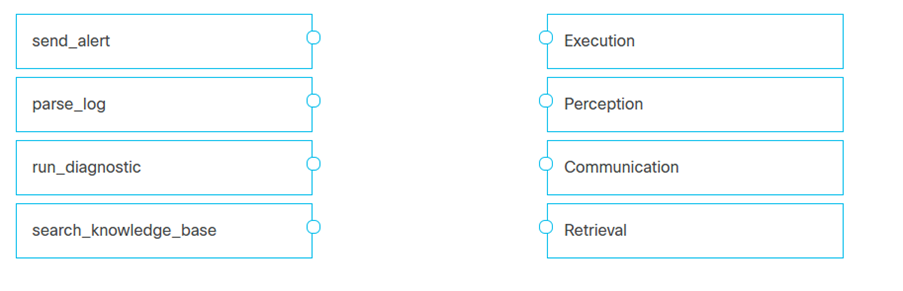
Match each tool to its correct category.

Ans

Question 10
An agent needs to
extract structured data from unstructured syslog entries. Which tool category
would be most appropriate?
- Retrieval
- Execution
- Communication
- Perception
Ans – Perception
Question 11
In the ReAct pattern,
what is the purpose of the “Observation” step?
- To generate a response for the user
- To receive and process the result of a
tool call - To decide which tool to use next
- To summarize the conversation history
Ans – To receive and process the result of a tool
call
Match each memory type to its appropriate
use case.

Ans

Question 12
A financial services
company needs to build an AI system to handle customer requests.
- Research customer account information
- Analyze transaction patterns for fraud
detection - Execute approved actions on accounts
- Generate audit reports
Each function requires
specialized tools and domain expertise. The compliance team requires a clear
audit trail of all decisions and a single point of accountability.
Which orchestration
pattern would be most appropriate?
- Peer-to-peer – agents can collaborate like
a team of specialists - Hierarchical – because there are multiple
levels of management - Supervisor – add more workers to the
central agent - Single agent – because the tasks are
simple enough for one agent
agent