Latest posts
-
Generative AI Fundamentals Explained for Beginners (With IT & Network Engineering Examples)
1. What is Generative AI? Generative AI is a type of artificial intelligence that creates new content instead of simply analyzing existing information. It can write text, generate images, create code, summarize reports, and even produce audio or videos. It learns patterns from massive datasets and uses those patterns to generate human-like responses. IT & Networking…
-
CI/CD Pipelines for Cisco ACI: Automate, Validate and Deploy Network Changes with Confidence
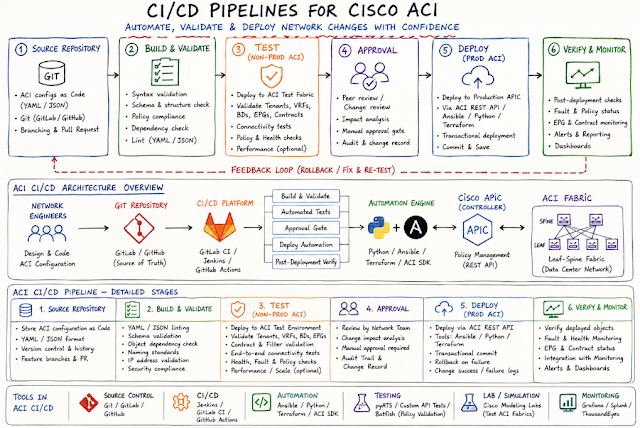
Modern data centers are becoming increasingly software-driven. Network engineers are no longer limited to configuring individual switches through the CLI; instead, infrastructure can be represented as code, stored in version-control systems, tested automatically, and deployed through controlled pipelines. This is where NetDevOps and CI/CD pipelines become highly relevant to Cisco ACI environments. Cisco ACI already…
-
Top 10 Cisco SD-WAN Multiple Choice Questions (MCQs) with Answers and Explanations
Cisco SD-WAN’s (Viptela-based) architecture separates control, management, orchestration, and data planes in a way that’s genuinely different from traditional WAN routing. The following ten questions cover the concepts that come up most often in interviews, certification prep, and real production troubleshooting — controller roles, OMP, TLOCs, BFD, and centralized policy. Question 1 What is the…
-
Top 9 Agentic AI Multiple Choice Questions (MCQs) with Answers and Explanations
Agentic AI is transforming how organizations automate operations, perform reasoning, and execute actions autonomously. The following questions cover key concepts including agent architecture, governance, frameworks, automation platforms, and AI risks. Question 1 A security team is deploying an agent that can quarantine potentially infected hosts. Which human-in-the-loop pattern is MOST appropriate? Options A. Notification only…
-
Anatomy of an AI Agent : Knowledge Assessment
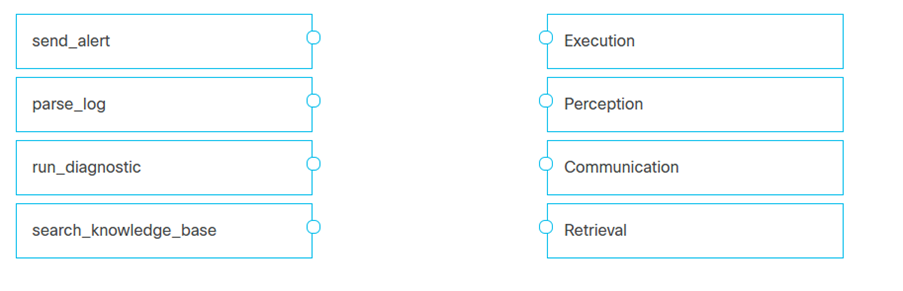
Question 1 In the plan-and-execute architecture, what is the key benefit of separating planning from execution? It reduces API costs It allows the agent to create an explicit roadmap before acting, making complex tasks more manageable It eliminates the need for tools It makes the agent respond faster Ans – It allows the agent…
-
Anatomy of an AI Agent for Cisco SD-WAN: 20+ Knowledge Assessment Questions & Answers
Anatomy of an AI Agent for Cisco SD-WAN: Knowledge Assessment for Network Engineers 1. Introduction AI agents are becoming increasingly relevant to network operations. For Cisco SD-WAN engineers, concepts such as planning, RAG, tool calling, ReAct, memory, context windows, Human-in-the-Loop, and multi-agent orchestration can be connected directly to real-world network troubleshooting. Imagine receiving an alert:…
-
Anatomy of an AI Agent for Cisco ACI: 20+ Knowledge Assessment Questions & Answers
Anatomy of an AI Agent for Cisco ACI: Knowledge Assessment for Network Engineers 1. Introduction Artificial Intelligence is becoming increasingly relevant to network operations. For Cisco ACI engineers, concepts such as AI agents, RAG, tool calling, ReAct, memory, planning, and Human-in-the-Loop can be applied to practical troubleshooting and automation scenarios. This assessment converts the…
-
Multi-Agent AI Systems Explained for Cisco SD-WAN Engineers: Supervisor, Peer-to-Peer, and Hierarchical Patterns
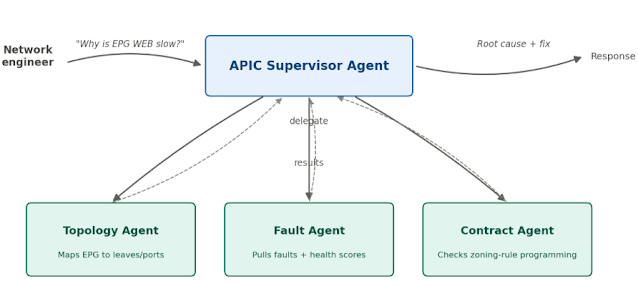
Multi-Agent AI Systems Explained for Cisco SD-WAN Engineers: Supervisor, Peer-to-Peer, and Hierarchical Patterns One AI agent can only be so good at everything. Ask it to inventory branches in a region, check tunnel health, correlate an SLA breach, and draft a fix — and you’re asking one generalist to do the job of four specialists.…
-
Multi-Agent AI Systems Explained for Cisco ACI Engineers: Supervisor, Peer-to-Peer, and Hierarchical Patterns
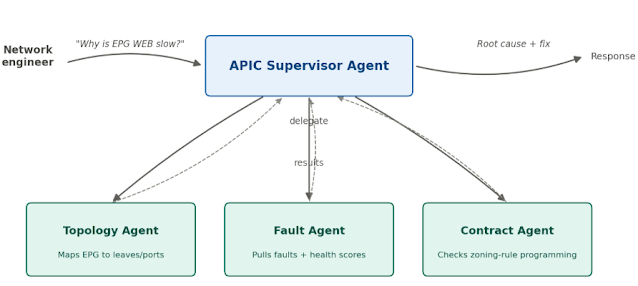
Multi-Agent AI Systems Explained for Cisco ACI Engineers: Supervisor, Peer-to-Peer, and Hierarchical Patterns One AI agent can only be so good at everything. Ask it to inventory devices in a Pod, check health scores, correlate a traffic anomaly, and draft a fix — and you’re asking one generalist to do the job of four…
-
The Agent Loop in Cisco SD-WAN: How AI Can Automate Network Troubleshooting
Artificial intelligence is changing the way network engineers approach monitoring, troubleshooting, and automation. Traditionally, a network engineer might receive an alert, log in to the Cisco SD-WAN management platform, check device health, investigate WAN links, examine tunnel status, review application performance, and then decide what action should be taken. Now imagine an AI agent performing…