Latest posts
-
Cisco Port Security Violation Modes: Protect mode vs Shutdown Vs Restrict
🔐 Understanding Cisco Port Security Violation Modes: A Practical Guide for Network Admins When it comes to securing your network at the access layer, Cisco Port Security is a powerful first line of defense. But what really makes it effective is how it handles violations—when an unauthorized device tries to connect. Cisco offers three distinct violation modes, each…
-
SNMP V1 vs SNMP V2 Vs SNMP V3
🔐 Understanding SNMP Versions: A Quick Guide to Network Monitoring Security In the world of network management, SNMP (Simple Network Management Protocol) plays a pivotal role in monitoring and managing devices across enterprise networks. Over the years, SNMP has evolved through multiple versions, each improving upon the last in terms of security, efficiency, and functionality. Let’s break down the key…
-
Core SNMP Operations Explained
Simple Network Management Protocol (SNMP) enables centralized monitoring and control of networked devices. It uses a set of well-defined operations to exchange management data between SNMP managers and agents. 1. GET Request Used to retrieve specific data from a managed device. It queries a particular object identifier (OID) to check the current status or configuration. 2. GET-NEXT Request This…
-
Cisco IOS XR – Important Information
Cisco IOS XR Q&A Summary Question 1 How many line card slots does the Cisco 8812 router have, including RP slots, and how many RU of space does it occupy? Correct Answer: The Cisco 8812 router has 12 slots in total (including RP slots) and occupies 21 RU of space. Explanation: The Cisco 8812…
-
Cisco nexus Switches( Cisco NX-OS) vs Cisco Catalyst Switches (Cisco IOS XE)
When building a network, selecting the right switch platform is crucial. Cisco offers two powerful families—Nexus and Catalyst—each optimized for different use cases. Here’s a side-by-side breakdown to help you understand which suits your environment best: Feature Cisco Nexus (NX-OS) Cisco Catalyst (IOS XE) Best Suited For Data centers where performance, scale, and speed are…
-
What is floating static route
A floating static route is a static route with a higher administrative distance than the primary route, so it only takes over if the primary route becomes unavailable. Example ip route 10.10.10.0 255.255.255.0 192.168.2.1 200
-
The standard order of accessing modes on a Cisco device
The standard order of accessing modes on a Cisco device (like a router or switch) running IOS or IOS XE is: ✅ User EXEC mode → Privileged EXEC mode → Global Configuration mode → Specific Configuration modes 📘 Detailed Order: User EXEC Mode (>) Access level: Basic Prompt: Router> Limited commands (e.g., ping, show…
-
Cisco IOS XE Devices – Switches Catalyst 9200 vs 9300 vs 9400 vs 9500 vs 9600 – Routers 8200 vs 8200L vs 8300 vs 8500
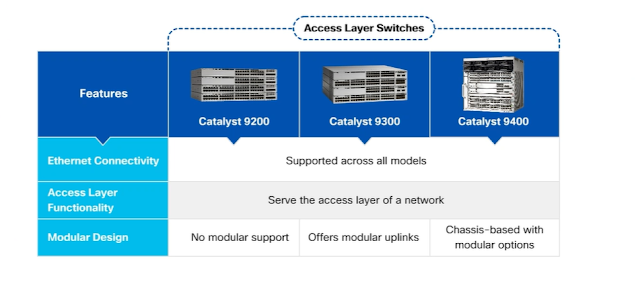
Switches Router
-
Create a Match-All Contract in Cisco ACI (via GUI)
Creating a “match all” contract in Cisco ACI means defining a contract that allows all traffic types (all protocols, all ports) between EPGs (Endpoint Groups). This is often used in lab environments or for initial testing, but should be used with caution in production due to its permissiveness. 🔧 Steps to Create a Match-All Contract in Cisco ACI (via…
-
Overview of BGP Aggregation
BGP route aggregation is a powerful feature that helps reduce the size of routing tables by summarizing multiple specific routes into a single, broader route. This is especially useful in large-scale networks where route optimization and scalability are critical. In Cisco IOS, the aggregate-address command provides flexible options to control how and when summary routes are advertised.…