Latest posts
-
How AI Memory Can Transform Cisco SD-WAN Operations: Working Memory, Long-Term Memory & RAG Explained with Real Examples
Enterprise WAN networks are becoming increasingly complex. A modern Cisco SD-WAN deployment may include hundreds of branch locations, multiple transport circuits, cloud connectivity, SaaS applications, and centralized policy management. While Cisco SD-WAN simplifies operations through centralized control, troubleshooting issues across multiple sites can still consume significant time. Imagine receiving alerts that twenty branch offices have…
-
How AI Memory Can Revolutionize Cisco ACI Operations
Cisco ACI has transformed data center networking by introducing policy-based automation, centralized management, and application-centric networking. However, as enterprise fabrics grow, troubleshooting becomes increasingly challenging. Imagine receiving multiple faults from different leaf switches after a maintenance window. Instead of manually checking APIC health, interface counters, contracts, endpoint learning, and event logs one by one, an…
-
How AI Agents Actually “Touch” Your SD-WAN Overlay: Tools, Schemas, and Guardrails Explained
An AI agent that can only talk isn’t much use to an SD-WAN operations team. It can summarize a wall of syslog you paste in, sure — but it can’t tell you a branch’s current BFD state right now, and it definitely shouldn’t be pushing a centralized policy change just because it “reasoned” its way…
-
How AI Agents Actually “Touch” Your Cisco ACI Fabric: Tools, Schemas, and Guardrails Explained
An AI agent that can only talk isn’t much use to an ACI operations team. It can summarize a fault log you paste in, sure — but it can’t tell you Leaf-104’s health score right now, and it definitely shouldn’t be pushing a contract change just because it “reasoned” its way there. What separates a…
-
AI Planning Strategies for SD-WAN Engineers: From a Single Edge Query to Multi-Site Policy Design
SD-WAN engineers already live in a world of layered decisions — underlay vs. overlay, per-app policy vs. site-wide policy, one control-plane failure that can silently affect hundreds of branches at once. That’s exactly the kind of environment where how an AI agent plans before it acts becomes critical, not optional. This post walks through the…
-
AI Planning Strategies for Cisco ACI Engineers: From a Single APIC Query to Multi-Site Design Decisions
If you run ACI in production, you already know the job isn’t really “networking” — it’s decision-making under a policy model. Every ticket forces the same question: is this a quick lookup, a known runbook, an investigation, a design choice, or something that needs a second pass before it goes live? AI agents face the…
-
AI Planning Strategies Explained for Network Engineers: From ReAct to Tree of Thoughts
Artificial Intelligence is rapidly becoming a key part of modern network operations. Whether you are managing a Cisco ACI fabric, troubleshooting Nexus switches, automating configuration changes, or investigating performance issues across multiple sites, understanding how AI agents think and execute tasks can help you work more efficiently. In this article, we will explore some popular…
-
AI Agent Reasoning Loop (ReAct) Explained for Network Engineers
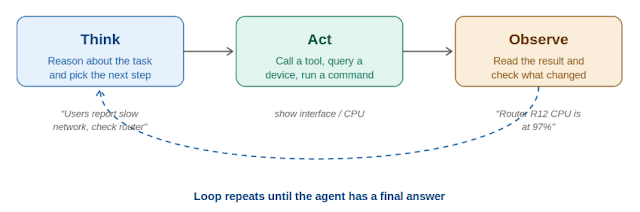
In the last post we covered how an agent perceives — how webhooks feed it events and how the context window works like a limited routing table. Perception only gets an agent halfway there, though. The real question is what it does with that information once it has it. That’s where the ReAct pattern comes…
-
AI Agent Perception and Context Windows Explained for Network Engineers
If you’ve already read up on what an LLM is or how temperature and tokens affect an AI agent’s behavior, there’s a step that comes before all of that reasoning even starts: perception. Before an agent can decide anything, it has to gather information and make sense of it — the same way a monitoring…
-
Understanding AI Agents for Network Engineers: LLMs, Prompts, Tokens and Context Explained
Artificial Intelligence is rapidly becoming part of modern network operations. From troubleshooting assistants to automated change management, AI agents are beginning to work alongside network engineers. But what exactly powers these agents? If you’ve configured routing protocols, built automation scripts, or managed network monitoring systems, understanding AI agents isn’t as complicated as it might seem.…