Latest posts
-
VTP type-2 configuration incompatible error in Cisco Nexus switch
If we get VTP type-2 configuration incompatible error in show VPC brief command as shown below. N7K-6-2(config)# show vPC brief Legend: (*) – local vPC is down, forwarding via vPC peer-link vPC domain id : 10 Peer status : peer adjacency formed ok vPC keep-alive status : peer is alive Configuration consistency status :…
-
Disk Subsystem Components – Storage Basics-3
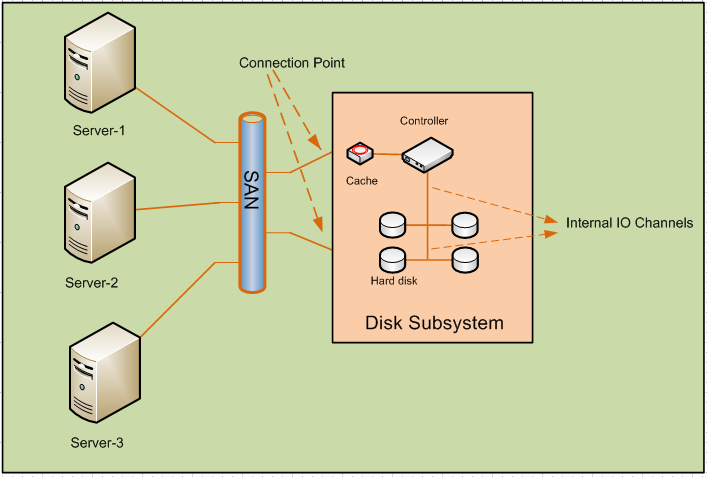
Every intelligent Disk subsystem consists of the below components. 1.SAN:- Server can be connected either directly to the disk subsystem or indirectly via Storage area network. SAN can be made up of SCSI, Fibre channel or iSCSI infrastructure. 2.Connection Points:- Servers are connected to Disk subsystem via connection points. Each subsystem must be connected more than…
-
Fabric Login Process – Storage Basics-9
Below are the three login processes which are responsible for the creation and maintenance of communication link between initiator and target. 1. Fabric Login:- It is known as FLOGI. It establishes the session between N-port and F-port. It is mandatory process for point-to-point and Fabric topology, without it N_port will not able to send or…
-
Fibre channel Protocol stack – Storage Basics-8
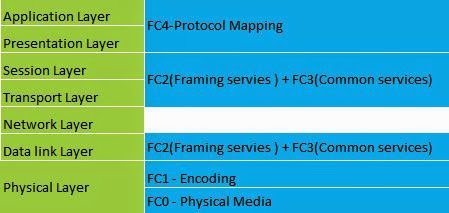
There are five layers in FC protocol stages which are quite similar to the OSI layer. 1. FC0:- It is equivalent to the physical Layer in OSI model. It belongs to the physical layer and defines the cable and connector used for the FC traffic. It sends the data in the form of bits “0”…
-
What is Mirroring? – Storage Basics-7
Mirroring is the process to provide redundancy. Data will be mirrored from one disk to another so that it can provide the fault tolerance in case of disk failure:- There are two types of mirroring as mentioned below:- 1. Instant Copying: – It mirrors the data locally to the different hard disk in the same enclosure.…
-
What is JBOD? – Storage Basics-5
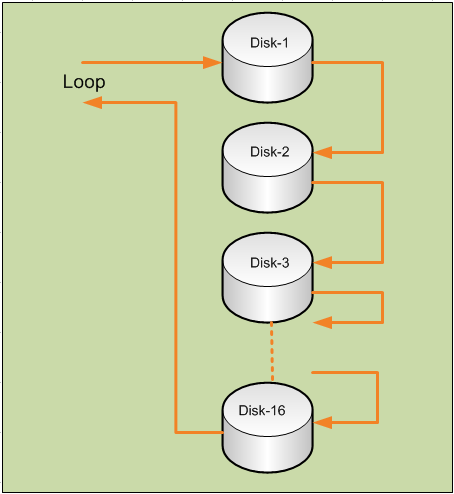
JBOD is just bunch of disk where all the disks are installed in an enclosure with common power supply. There is no controller present in JBOD and hence it cannot provide any RAID capability. Generally it has either 8 or 16 disks. Server will see each disk as independent disk and each require its own…
-
What is LUN masking? – Storage Basics-6
Controller abstracts all the physical disks to a single virtual disk and hence all servers will be able to see all the hard disk. Error generated by one server can impact the complete disk subsystem. LUN masking is the method by which servers will get access to the space they are allowed to. Server cannot…
-
What is RAID? – Storage Basics-4
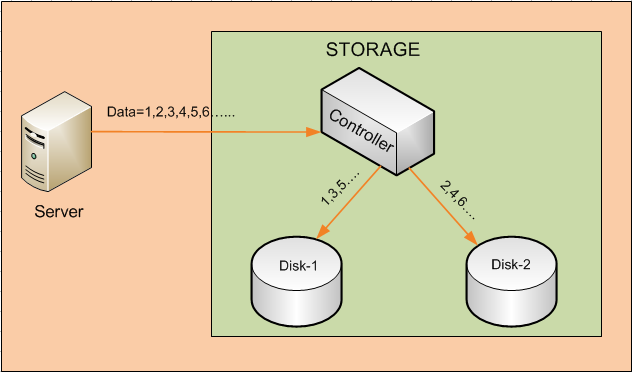
RAID stands for Redundant Array of Independent Disk. It is a method used to store the data efficiently onto the hard disk. It gives the method that not only distribute the data on various disks but also provide the mechanism which helps in providing the redundancy. To understand the RAID methods we must understand the below terms:-…
-
Disk Subsystem – Storage Basics-2
In storage, the directly connected small disks are replaced by large storage subsystems connected via storage network. It has the flexibility to assigned hard disk to the servers as per the availability. Servers are either connected to Disk subsystem directly or indirectly via SAN ( storage Area Network). There are below advantages of using storage…
-
IT Architecture – Storage Basics-1
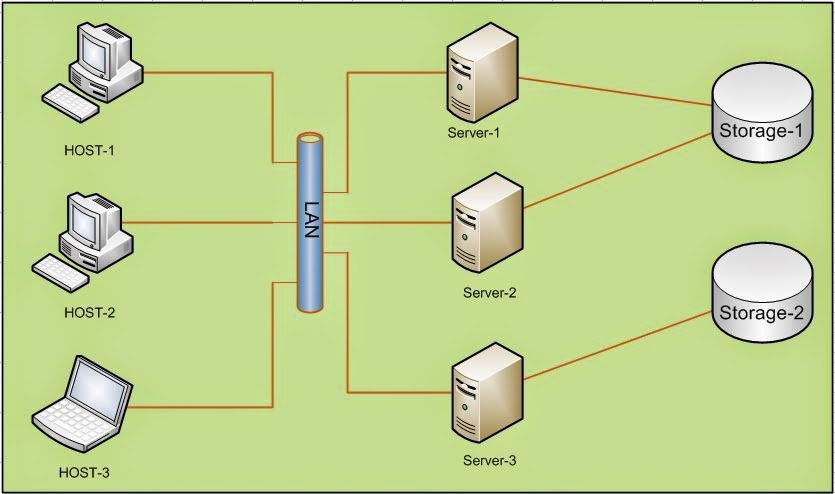
IT Architecture IT architecture describes the way servers and hosts accessing the storage. Storage consists of various disks which are shared between the hosts. It is deployed in the environment where there is a requirement of shared memory between the server e.g shared drives. Storage disks are appeared as the directly attached disk to the…