There are five layers in FC
protocol stages which are quite similar to the OSI layer.
protocol stages which are quite similar to the OSI layer.
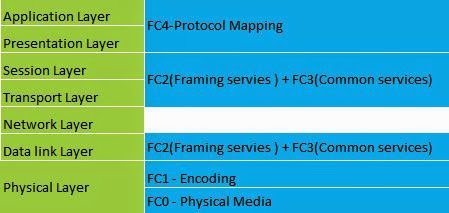
1. FC0:- It is equivalent
to the physical Layer in OSI model. It belongs to the physical layer and
defines the cable and connector used for the FC traffic. It sends the data in
the form of bits “0” and “1” sequentially.
to the physical Layer in OSI model. It belongs to the physical layer and
defines the cable and connector used for the FC traffic. It sends the data in
the form of bits “0” and “1” sequentially.
FC hubs are working in FC0 layer.
2. FC1:- It is
responsible for the data encoding. It ensures the data error correction will be
done in case of error.
responsible for the data encoding. It ensures the data error correction will be
done in case of error.
It also performs the link creation and maintenance. It is
equivalent to data link layer of OSI model.
equivalent to data link layer of OSI model.
8b/10b encoding
is used in 1Gig, 2Gig, 4Gig, 8Gig whereas 10Gig and 16Gig standard uses 64b/66b encoding.
is used in 1Gig, 2Gig, 4Gig, 8Gig whereas 10Gig and 16Gig standard uses 64b/66b encoding.
3. FC2:- It is the most
important layer in FC protocol stack which perform various critical functions.
It is equivalent to network OSI layer and is defined in FC-PI-2 standard.
important layer in FC protocol stack which perform various critical functions.
It is equivalent to network OSI layer and is defined in FC-PI-2 standard.
FC
switches works on FC2 layer.
switches works on FC2 layer.
FC2
layer performs the below functions:-
layer performs the below functions:-
A. Data
block size handling: – It
defines how big data payloads can be send over the network. Below are the few key words:-
block size handling: – It
defines how big data payloads can be send over the network. Below are the few key words:-
- Exchange:-
Exchange is the session built between end machines to transmit and receive
data. There can be multiple Exchanges between the hosts. - Sequence:
– Payload or data is made up of big data units called sequence. It
ensures the correct order of delivery as well and eliminates the out of order
issues. - Frames:
– Since each link can only sent a defined amount of data size. The big
data blocks are broken down to smaller chucks known as Frames. Frames can
consist of up to 2112 bytes. If one frame is lost then the entire sequence has
to be retransmitted
FC2 not only ensures that the frame has
been received successfully at the receiver end but it also makes sure that the
frames are been sent or received in sequence.
been received successfully at the receiver end but it also makes sure that the
frames are been sent or received in sequence.
B. Flow
control: – It provides the flow control to avoid the situation
at the receivers end and is known as credit limit. It makes sure that both
transmitter and receiver are in sync and transmitter will not overload the
receiver. It performs two types of flow control:-
control: – It provides the flow control to avoid the situation
at the receivers end and is known as credit limit. It makes sure that both
transmitter and receiver are in sync and transmitter will not overload the
receiver. It performs two types of flow control:-
- Buffer-to-buffer
credit: – It is also known as link flow control in which both end of
the link negotiate data speed. - End-to-End
flow control:- In End-to-End flow control, the speed is negotiated
between transmitter and receiver
C. Addressing:-
Each device in the fabric has its
own unique WWNN (world wide node name) and each port gets a 64-bit address
called WWPN (world wide port name). As soon as port is up neighbor switch will
assign a 24 bit value called FCID to it.
4. FC3:- It performs the below mentioned
services as mentioned below. It is not used in FC protocols and can be used by
using additional software but not implemented yet.
services as mentioned below. It is not used in FC protocols and can be used by
using additional software but not implemented yet.
- Encryption
- Mirroring
or RAID - Compression
5. FC4:- It is used to map the protocol data
to the below layer. It encapsulates the data units and sends it to FC2 to
perform the lower layer functions.
to the below layer. It encapsulates the data units and sends it to FC2 to
perform the lower layer functions.