Concept of vPC in
ACI
In Cisco ACI, a Virtual
Port Channel (vPC) enables two separate leaf switches to present a
unified port channel to a connected endpoint—such as a server, firewall, or
another switch that supports link aggregation protocols like LACP.
In this setup, two ACI
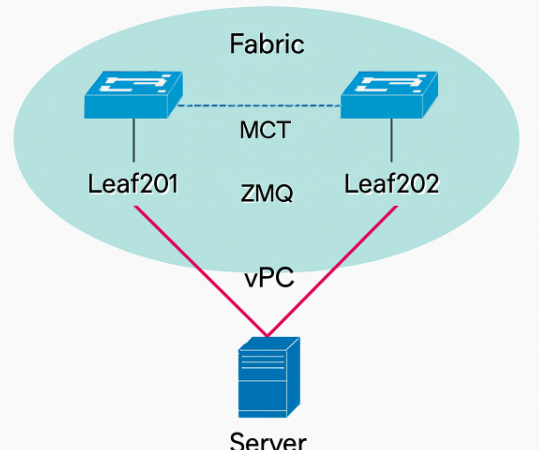
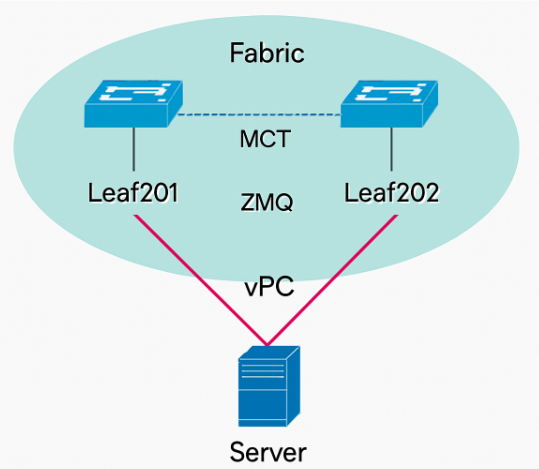
leaf nodes (e.g., Leaf201 and Leaf202) act
as vPC peers, forming a logical construct known as a vPC
domain. One of these peers is elected as the primary, while the
other assumes the secondary role.
ACI’s MCT-Based
Architecture
Unlike traditional vPC
implementations that rely on a dedicated peer-link, ACI leverages
the fabric itself to manage synchronization and control-plane communication.
This architecture is referred to as Multichassis EtherChannel Trunk
(MCT).
🔧 Key Characteristics:
- No physical peer-link is required between Leaf201 and
Leaf202. - Instead, the ACI fabric handles all peer
communication and synchronization. - ZMQ (Zero Message Queue) replaces traditional CFS (Cisco
Fabric Services) for messaging between vPC peers.
How Peer
Communication Works in ACI
- ZMQ, a high-performance messaging library using TCP, is embedded
as libzmq on each switch. - Applications that require peer
communication (like the vPC manager) use this library to exchange
messages.
🔄 Peer Reachability Mechanism:
- The vPC manager subscribes
to routing updates via URIB. - When IS-IS discovers a
route to the peer (e.g., Leaf202 sees Leaf201), URIB notifies the vPC
manager. - The manager then attempts to establish
a ZMQ socket with the peer. - If the route is withdrawn (e.g., due to
link failure), the vPC manager is notified and the MCT link is brought
down accordingly.
Upgrade Best
Practices with vPC
To ensure high
availability during fabric upgrades, it’s recommended to divide switches into
at least two upgrade groups. For example:
- Group A: Leaf201, Leaf203, Spine101
- Group B: Leaf202, Leaf204, Spine102
This strategy ensures
that at least one vPC peer remains active during the upgrade, preventing
service disruption for connected endpoints.
Glossary
|
Term |
Description |
|
ACI |
Application Centric |
|
vPC |
Virtual Port Channel |
|
MCT |
Multichassis |
|
ZMQ |
Zero Message Queue |
|
URIB |
Unicast Routing |
|
IS-IS |
Intermediate System |
|
LACP |
Link Aggregation |
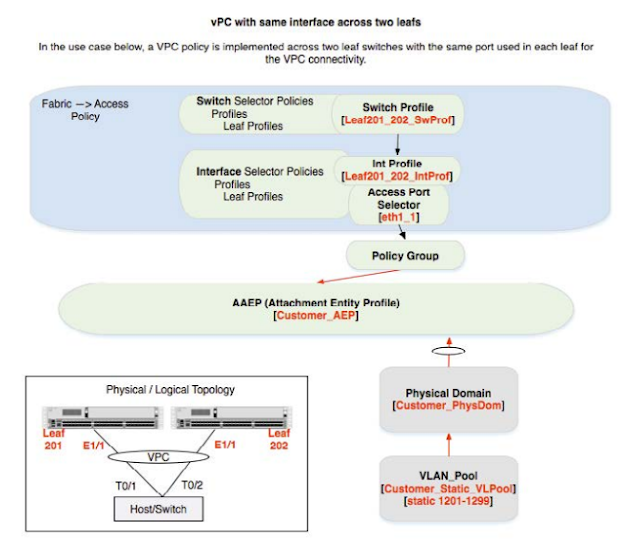
Option 1 -VPC with SAME Leaf interfaces across two leafs with Combined Profiles
Option 2 – VPC with SAME Leaf interfaces across two leafs with Individual Profiles.
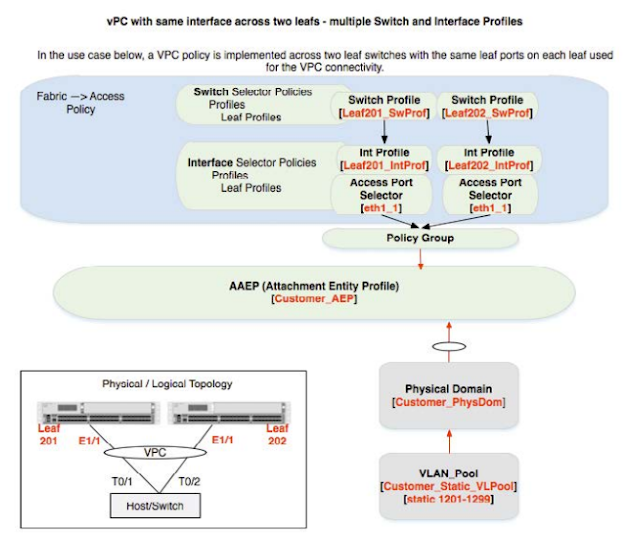
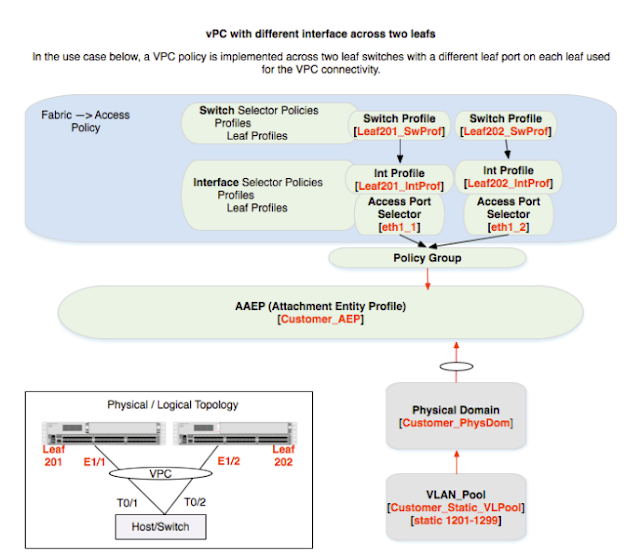
Option 3 – VPC with DIFFERENT Leaf interfaces across two leafs with Individual
Profiles