What is TOP OF
RACK (TOR)?
RACK (TOR)?
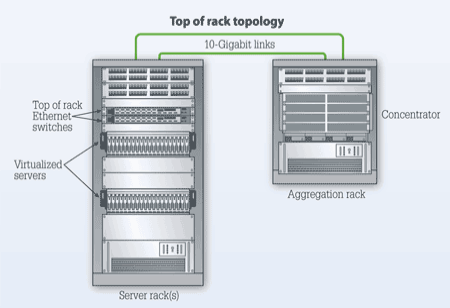
In TOR, there is one or two access switch installed on
the top of each server rack which provides servers network connectivity and
then that access switch has the connections towards the aggregation switch
which is located in the Network Rack. Hence there are only few cables going
from server Rack to the network Rack.
the top of each server rack which provides servers network connectivity and
then that access switch has the connections towards the aggregation switch
which is located in the Network Rack. Hence there are only few cables going
from server Rack to the network Rack.
Advantage:-
·
Cabling
Cost: – It reduces the cable requirement as all servers connections are
terminated to its own Rack. And hence there are only few cables running between the server and network racks.
Cabling
Cost: – It reduces the cable requirement as all servers connections are
terminated to its own Rack. And hence there are only few cables running between the server and network racks.
·
Cable
management: – Less resources and skills are needed to manage the cabling
infrastructure.
Cable
management: – Less resources and skills are needed to manage the cabling
infrastructure.
·
Easy management and changes: – Since very
less number of cable running between server and network rack, it is quite easy
to locate the cable and make changes.
Easy management and changes: – Since very
less number of cable running between server and network rack, it is quite easy
to locate the cable and make changes.
Disadvantage:-
·
Switch
management: – As each Rack requires one or two local switches, the
management of the switch becomes an overhead. It requires not only extra IPs
but also management tool that manages inventory and configuration of the
devices. Tools have its own capability to monitor the maximum number of devices.
More devices in the network, more license cost etc.
·
Network
resources: – As there are more managed devices, it require more network
resources to manage the infrastructure.
Network
resources: – As there are more managed devices, it require more network
resources to manage the infrastructure.
·
BW
requirement:- This is only for the legacy environment where 10/40/100 Gig
links are not present. As there are only few uplink available to access switch
there can be issues with the BW available.
BW
requirement:- This is only for the legacy environment where 10/40/100 Gig
links are not present. As there are only few uplink available to access switch
there can be issues with the BW available.
·
More rack
space: We require more rack space to install SAN and LAN switches in the
server rack. It in turns increases the overall Rack requirement.
More rack
space: We require more rack space to install SAN and LAN switches in the
server rack. It in turns increases the overall Rack requirement.
·
More
Space in Datacenters: – As the space requirement is very critical and
expensive criteria to datacenter design and we always try to make our DC compact
and efficient. As stated above more rack space can increase DC space
requirement.
More
Space in Datacenters: – As the space requirement is very critical and
expensive criteria to datacenter design and we always try to make our DC compact
and efficient. As stated above more rack space can increase DC space
requirement.
What is END OF ROW ( EOR )?
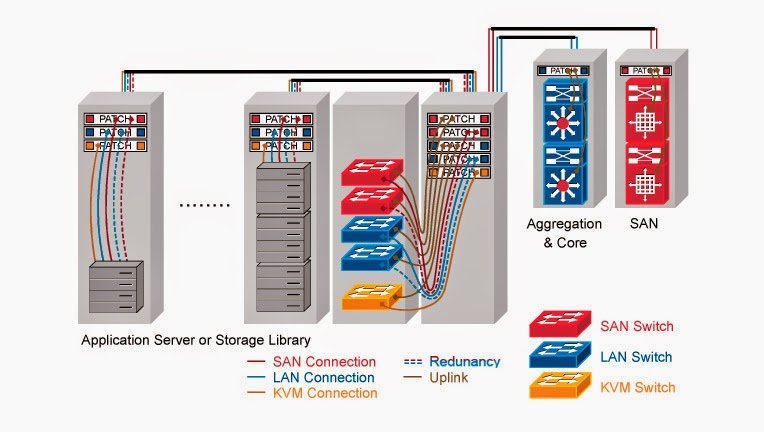
In EOR, all the network switches are placed in network
rack only whereas cable from each server, located in server racks, runs towards
the network rack.
rack only whereas cable from each server, located in server racks, runs towards
the network rack.
Advantage:-
·
Less device
count: – As we needn’t to install switches in each rack, the number of required
switches reduces. In TOR, each rack must have a switch whether the rack is
fully loaded or not, that reduces the device count.
Less device
count: – As we needn’t to install switches in each rack, the number of required
switches reduces. In TOR, each rack must have a switch whether the rack is
fully loaded or not, that reduces the device count.
·
Rack
space: – As the overall device count reduces and hence it requires less
space.
Rack
space: – As the overall device count reduces and hence it requires less
space.
·
Cooling
requirement:- Less devices in datacenter, less is the Cooling requirement.
It also reduces the electricity bills and resources needed to maintain the DC
environment.
Cooling
requirement:- Less devices in datacenter, less is the Cooling requirement.
It also reduces the electricity bills and resources needed to maintain the DC
environment.
Disadvantage:-
·
Inefficient
Layer 2 traffic: – We all know that traffic from East to west is more than
top to bottom. In EOR design, if two servers in same rack and vlan need to talk
to each other, the traffic will go to the aggregation switch in network rack
and then comes back. And hence reduces the efficiency.
Inefficient
Layer 2 traffic: – We all know that traffic from East to west is more than
top to bottom. In EOR design, if two servers in same rack and vlan need to talk
to each other, the traffic will go to the aggregation switch in network rack
and then comes back. And hence reduces the efficiency.
Similarly in case of TOR, traffic could
easily and efficiently switched by the local switch present on the server rack.
It could not only reduce the traffic on uplinks but also saves CPU and memory
consumption of the aggregate or core switches.
easily and efficiently switched by the local switch present on the server rack.
It could not only reduce the traffic on uplinks but also saves CPU and memory
consumption of the aggregate or core switches.
·
Cable
requirement: – As cable runs between each server and network switch,
located in different racks, increases of cable requirement and add cost to the
deployment and maintenance.
Cable
requirement: – As cable runs between each server and network switch,
located in different racks, increases of cable requirement and add cost to the
deployment and maintenance.
·
Cable
management: – More resources and skill required for cable management. It increases
the overall budget of the project.
Cable
management: – More resources and skill required for cable management. It increases
the overall budget of the project.
·
Time to
make changes: – As more cabling infrastructure is involved, modification
not only becomes tedious but also require more time.
Time to
make changes: – As more cabling infrastructure is involved, modification
not only becomes tedious but also require more time.
Related Links-
AI Related Articles
https://netterrene.com/2026/06/generative-ai-quiz-beginners-mcq-answers.html
Data Center Architecture
- Cisco Data Center Foundation — Practice Exam 1 (Spine-Leaf, Three-Tier, SAN, HCI)
- Why We Need Nexus 2K (FEX)? — An Alternative to ToR Switches
- Why We Need VPC? — Redundancy for ToR Switch Uplinks
- VPC FAQs
- OTV FAQs — Multi-DC Layer 2 Extension
- FabricPath FAQs — DC Fabric Technology
EoR Switch Hardware (Nexus 7000)
- Cisco 7700 VS 7000 Nexus Switch Comparison
- F1 Vs. F2 Vs. F2E Vs. F3 — Cisco Nexus 7000 Line Cards
- Difference Between M-Series and F-Series Cards in Nexus 7000
- Shared Vs. Dedicated Port Mode in Nexus 7000
- Default Vs. Admin VDC in Nexus 7000
- VDC User Roles in Nexus 7000
ToR Switch Hardware (Nexus 5500)