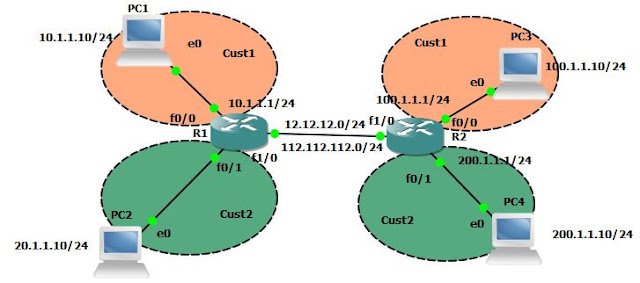

PC1:-
PC1> show ip
NAME : PC1[1]
IP/MASK : 10.1.1.10/24
GATEWAY : 10.1.1.1
DNS :
MAC : 00:50:79:66:68:00
LPORT : 10000
RHOST:PORT : 192.168.56.1:10001
MTU: : 1500
Verification:-
PC1> ping 10.1.1.1
84 bytes from 10.1.1.1
icmp_seq=1 ttl=255 time=46.746 ms
icmp_seq=1 ttl=255 time=46.746 ms
84 bytes from 10.1.1.1
icmp_seq=2 ttl=255 time=47.038 ms
icmp_seq=2 ttl=255 time=47.038 ms
84 bytes from 10.1.1.1
icmp_seq=3 ttl=255 time=37.015 ms
icmp_seq=3 ttl=255 time=37.015 ms
84 bytes from 10.1.1.1
icmp_seq=4 ttl=255 time=47.171 ms
icmp_seq=4 ttl=255 time=47.171 ms
84 bytes from 10.1.1.1
icmp_seq=5 ttl=255 time=47.015 ms
icmp_seq=5 ttl=255 time=47.015 ms
PC1> ping 12.12.12.1
84 bytes from 12.12.12.1
icmp_seq=1 ttl=255 time=55.690 ms
icmp_seq=1 ttl=255 time=55.690 ms
84 bytes from 12.12.12.1
icmp_seq=2 ttl=255 time=49.691 ms
icmp_seq=2 ttl=255 time=49.691 ms
84 bytes from 12.12.12.1
icmp_seq=3 ttl=255 time=48.370 ms
icmp_seq=3 ttl=255 time=48.370 ms
84 bytes from 12.12.12.1
icmp_seq=4 ttl=255 time=56.310 ms
icmp_seq=4 ttl=255 time=56.310 ms
84 bytes from 12.12.12.1
icmp_seq=5 ttl=255 time=47.085 ms
icmp_seq=5 ttl=255 time=47.085 ms
PC1> ping 12.12.12.2
84 bytes from 12.12.12.2
icmp_seq=1 ttl=254 time=87.149 ms
icmp_seq=1 ttl=254 time=87.149 ms
84 bytes from 12.12.12.2
icmp_seq=2 ttl=254 time=93.756 ms
icmp_seq=2 ttl=254 time=93.756 ms
84 bytes from 12.12.12.2 icmp_seq=3
ttl=254 time=93.756 ms
ttl=254 time=93.756 ms
84 bytes from 12.12.12.2
icmp_seq=4 ttl=254 time=78.428 ms
icmp_seq=4 ttl=254 time=78.428 ms
84 bytes from 12.12.12.2
icmp_seq=5 ttl=254 time=93.904 ms
icmp_seq=5 ttl=254 time=93.904 ms
PC1> ping 100.1.1.1
84 bytes from 100.1.1.1
icmp_seq=1 ttl=254 time=93.761 ms
icmp_seq=1 ttl=254 time=93.761 ms
84 bytes from 100.1.1.1
icmp_seq=2 ttl=254 time=94.341 ms
icmp_seq=2 ttl=254 time=94.341 ms
84 bytes from 100.1.1.1
icmp_seq=3 ttl=254 time=78.159 ms
icmp_seq=3 ttl=254 time=78.159 ms
84 bytes from 100.1.1.1
icmp_seq=4 ttl=254 time=77.972 ms
icmp_seq=4 ttl=254 time=77.972 ms
84 bytes from 100.1.1.1
icmp_seq=5 ttl=254 time=93.908 ms
icmp_seq=5 ttl=254 time=93.908 ms
PC1> ping 100.1.1.10
100.1.1.10 icmp_seq=1
timeout
timeout
100.1.1.10 icmp_seq=2
timeout
timeout
84 bytes from 100.1.1.10
icmp_seq=3 ttl=62 time=62.595 ms
icmp_seq=3 ttl=62 time=62.595 ms
84 bytes from 100.1.1.10
icmp_seq=4 ttl=62 time=62.613 ms
icmp_seq=4 ttl=62 time=62.613 ms
84 bytes from 100.1.1.10 icmp_seq=5
ttl=62 time=62.560 ms
ttl=62 time=62.560 ms
PC2:-
C2> show ip
NAME : PC2[1]
IP/MASK : 20.1.1.10/24
GATEWAY : 20.1.1.1
DNS :
MAC : 00:50:79:66:68:01
LPORT : 10002
RHOST:PORT : 192.168.56.1:10003
MTU: : 1500
Verification:-
PC2> ping 200.1.1.10
200.1.1.10 icmp_seq=1
timeout
timeout
200.1.1.10 icmp_seq=2
timeout
timeout
84 bytes from 200.1.1.10
icmp_seq=3 ttl=62 time=62.585 ms
icmp_seq=3 ttl=62 time=62.585 ms
84 bytes from 200.1.1.10
icmp_seq=4 ttl=62 time=62.783 ms
icmp_seq=4 ttl=62 time=62.783 ms
84 bytes from 200.1.1.10
icmp_seq=5 ttl=62 time=62.385 ms
icmp_seq=5 ttl=62 time=62.385 ms
R1:-
ip vrf cust1
ip vrf cust2
interface FastEthernet0/0
ip vrf forwarding cust1
ip address 10.1.1.1 255.255.255.0
speed auto
duplex auto
!
interface FastEthernet0/1
ip vrf forwarding cust2
ip address 20.1.1.1 255.255.255.0
speed auto
duplex auto
interface
FastEthernet1/0.10
FastEthernet1/0.10
encapsulation dot1Q 10
ip vrf forwarding cust1
ip address 12.12.12.1 255.255.255.0
interface
FastEthernet1/0.20
FastEthernet1/0.20
encapsulation dot1Q 20
ip vrf forwarding cust2
ip address 112.112.112.1 255.255.255.0
ip route vrf cust1 0.0.0.0
0.0.0.0 12.12.12.2
0.0.0.0 12.12.12.2
ip route vrf cust2 0.0.0.0
0.0.0.0 112.112.112.2
0.0.0.0 112.112.112.2
Verification:-
R1#sh ip vrf
Name Default RD Interfaces
cust1 <not
set> Fa0/0
set> Fa0/0
Fa1/0.10
cust2 <not
set> Fa0/1
set> Fa0/1
Fa1/0.20
R1#show ip route vrf cust1
Routing Table: cust1
Codes: L – local, C –
connected, S – static, R – RIP, M – mobile, B – BGP
connected, S – static, R – RIP, M – mobile, B – BGP
D – EIGRP, EX – EIGRP external, O –
OSPF, IA – OSPF inter area
OSPF, IA – OSPF inter area
N1 – OSPF NSSA external type 1, N2 –
OSPF NSSA external type 2
OSPF NSSA external type 2
E1 – OSPF external type 1, E2 – OSPF external
type 2
type 2
i – IS-IS, su – IS-IS summary, L1 –
IS-IS level-1, L2 – IS-IS level-2
IS-IS level-1, L2 – IS-IS level-2
ia – IS-IS inter area, * – candidate
default, U – per-user static route
default, U – per-user static route
o – ODR, P – periodic downloaded static
route, H – NHRP
route, H – NHRP
+ – replicated route, % – next hop
override
override
Gateway of last resort is
12.12.12.2 to network 0.0.0.0
12.12.12.2 to network 0.0.0.0
S* 0.0.0.0/0 [1/0] via 12.12.12.2
10.0.0.0/8 is variably subnetted, 2
subnets, 2 masks
subnets, 2 masks
C 10.1.1.0/24 is directly connected,
FastEthernet0/0
FastEthernet0/0
L 10.1.1.1/32 is directly connected,
FastEthernet0/0
FastEthernet0/0
12.0.0.0/8 is variably subnetted, 2
subnets, 2 masks
subnets, 2 masks
C 12.12.12.0/24 is directly connected,
FastEthernet1/0.10
FastEthernet1/0.10
L 12.12.12.1/32 is directly connected,
FastEthernet1/0.10
FastEthernet1/0.10
R1#ping vrf cust1 10.1.1.1
Type escape sequence to
abort.
abort.
Sending 5, 100-byte ICMP
Echos to 10.1.1.1, timeout is 2 seconds:
Echos to 10.1.1.1, timeout is 2 seconds:
!!!!!
Success rate is 100
percent (5/5), round-trip min/avg/max = 4/7/8 ms
percent (5/5), round-trip min/avg/max = 4/7/8 ms
R1#ping vrf cust1 10.1.1.10
Type escape sequence to
abort.
abort.
Sending 5, 100-byte ICMP
Echos to 10.1.1.10, timeout is 2 seconds:
Echos to 10.1.1.10, timeout is 2 seconds:
!!!!!
Success rate is 100
percent (5/5), round-trip min/avg/max = 4/48/64 ms
percent (5/5), round-trip min/avg/max = 4/48/64 ms
R1#ping vrf cust1 100.1.1.10
Type escape sequence to
abort.
abort.
Sending 5, 100-byte ICMP
Echos to 100.1.1.10, timeout is 2 seconds:
Echos to 100.1.1.10, timeout is 2 seconds:
.!!!!
Success rate is 80 percent
(4/5), round-trip min/avg/max = 84/342/1104 ms
(4/5), round-trip min/avg/max = 84/342/1104 ms
R1#show ip route vrf cust2
Routing Table: cust2
Codes: L – local, C –
connected, S – static, R – RIP, M – mobile, B – BGP
connected, S – static, R – RIP, M – mobile, B – BGP
D – EIGRP, EX – EIGRP external, O –
OSPF, IA – OSPF inter area
OSPF, IA – OSPF inter area
N1 – OSPF NSSA external type 1, N2 –
OSPF NSSA external type 2
OSPF NSSA external type 2
E1 – OSPF external type 1, E2 – OSPF
external type 2
external type 2
i – IS-IS, su – IS-IS summary, L1 –
IS-IS level-1, L2 – IS-IS level-2
IS-IS level-1, L2 – IS-IS level-2
ia – IS-IS inter area, * – candidate
default, U – per-user static route
default, U – per-user static route
o – ODR, P – periodic downloaded static
route, H – NHRP
route, H – NHRP
+ – replicated route, % – next hop
override
override
Gateway of last resort is
112.112.112.2 to network 0.0.0.0
112.112.112.2 to network 0.0.0.0
S* 0.0.0.0/0 [1/0] via 112.112.112.2
20.0.0.0/8 is variably subnetted, 2
subnets, 2 masks
subnets, 2 masks
C 20.1.1.0/24 is directly connected,
FastEthernet0/1
FastEthernet0/1
L 20.1.1.1/32 is directly connected,
FastEthernet0/1
FastEthernet0/1
112.0.0.0/8 is variably subnetted, 2
subnets, 2 masks
subnets, 2 masks
C 112.112.112.0/24 is directly connected,
FastEthernet1/0.20
FastEthernet1/0.20
L 112.112.112.1/32 is directly connected,
FastEthernet1/0.20
FastEthernet1/0.20
R1#ping vrf cust2 20.1.1.10
Type escape sequence to
abort.
abort.
Sending 5, 100-byte ICMP
Echos to 20.1.1.10, timeout is 2 seconds:
Echos to 20.1.1.10, timeout is 2 seconds:
!!!!!
Success rate is 100
percent (5/5), round-trip min/avg/max = 4/52/156 ms
percent (5/5), round-trip min/avg/max = 4/52/156 ms
R1#ping vrf cust2 200.1.1.10
Type escape sequence to
abort.
abort.
Sending 5, 100-byte ICMP
Echos to 200.1.1.10, timeout is 2 seconds:
Echos to 200.1.1.10, timeout is 2 seconds:
.!!!!
Success rate is 80 percent
(4/5), round-trip min/avg/max = 92/350/1112 ms
(4/5), round-trip min/avg/max = 92/350/1112 ms
R1#
PC3:-
PC3> show ip
NAME : PC3[1]
IP/MASK : 100.1.1.10/24
GATEWAY : 100.1.1.1
DNS :
MAC : 00:50:79:66:68:02
LPORT : 10005
RHOST:PORT : 192.168.56.1:10004
MTU: : 1500
Verification:-
PC3> ping 10.1.1.10
10.1.1.10 icmp_seq=1
timeout
timeout
10.1.1.10 icmp_seq=2
timeout
timeout
84 bytes from 10.1.1.10
icmp_seq=3 ttl=62 time=62.635 ms
icmp_seq=3 ttl=62 time=62.635 ms
84 bytes from 10.1.1.10
icmp_seq=4 ttl=62 time=62.703 ms
icmp_seq=4 ttl=62 time=62.703 ms
84 bytes from 10.1.1.10
icmp_seq=5 ttl=62 time=79.737 ms
icmp_seq=5 ttl=62 time=79.737 ms
PC4:-
PC4> show ip
NAME : PC4[1]
IP/MASK : 200.1.1.10/24
GATEWAY : 200.1.1.1
DNS :
MAC : 00:50:79:66:68:03
LPORT : 10007
RHOST:PORT : 192.168.56.1:10006
MTU: : 1500
Verification:-
PC4> ping 20.1.1.10
20.1.1.10 icmp_seq=1
timeout
timeout
20.1.1.10 icmp_seq=2
timeout
timeout
84 bytes from 20.1.1.10
icmp_seq=3 ttl=62 time=62.470 ms
icmp_seq=3 ttl=62 time=62.470 ms
84 bytes from 20.1.1.10
icmp_seq=4 ttl=62 time=46.973 ms
icmp_seq=4 ttl=62 time=46.973 ms
84 bytes from 20.1.1.10
icmp_seq=5 ttl=62 time=62.796 ms
icmp_seq=5 ttl=62 time=62.796 ms
R2:-
ip vrf cust1
ip vrf cust2
interface FastEthernet0/0
ip vrf forwarding cust1
ip address 100.1.1.1 255.255.255.0
speed auto
duplex auto
interface FastEthernet0/1
ip vrf forwarding cust2
ip address 200.1.1.1 255.255.255.0
speed auto
duplex auto
interface
FastEthernet1/0.10
FastEthernet1/0.10
encapsulation dot1Q 10
ip vrf forwarding cust1
ip address 12.12.12.2 255.255.255.0
interface
FastEthernet1/0.20
FastEthernet1/0.20
encapsulation dot1Q 20
ip vrf forwarding cust2
ip address 112.112.112.2 255.255.255.0
ip route vrf cust1 0.0.0.0
0.0.0.0 12.12.12.1
0.0.0.0 12.12.12.1
ip route vrf cust2 0.0.0.0
0.0.0.0 112.112.112.1
0.0.0.0 112.112.112.1
Verification:-
R2#sh ip vrf
Name Default RD Interfaces
cust1 <not
set> Fa0/0
set> Fa0/0
Fa1/0.10
cust12 <not set>
cust2 <not
set> Fa0/1
set> Fa0/1
Fa1/0.20
R2#show ip route vrf cust1
Routing Table: cust1
Codes: L – local, C – connected, S – static, R – RIP, M –
mobile, B – BGP
mobile, B – BGP
D – EIGRP,
EX – EIGRP external, O – OSPF, IA – OSPF inter area
EX – EIGRP external, O – OSPF, IA – OSPF inter area
N1 – OSPF
NSSA external type 1, N2 – OSPF NSSA external type 2
NSSA external type 1, N2 – OSPF NSSA external type 2
E1 – OSPF
external type 1, E2 – OSPF external type 2
external type 1, E2 – OSPF external type 2
i – IS-IS,
su – IS-IS summary, L1 – IS-IS level-1, L2 – IS-IS level-2
su – IS-IS summary, L1 – IS-IS level-1, L2 – IS-IS level-2
ia – IS-IS
inter area, * – candidate default, U – per-user static route
inter area, * – candidate default, U – per-user static route
o – ODR, P –
periodic downloaded static route, H – NHRP
periodic downloaded static route, H – NHRP
+ –
replicated route, % – next hop override
replicated route, % – next hop override
Gateway of last resort is 12.12.12.1 to network 0.0.0.0
S* 0.0.0.0/0
[1/0] via 12.12.12.1
[1/0] via 12.12.12.1
12.0.0.0/8 is
variably subnetted, 2 subnets, 2 masks
variably subnetted, 2 subnets, 2 masks
C
12.12.12.0/24 is directly connected, FastEthernet1/0.10
12.12.12.0/24 is directly connected, FastEthernet1/0.10
L
12.12.12.2/32 is directly connected, FastEthernet1/0.10
12.12.12.2/32 is directly connected, FastEthernet1/0.10
100.0.0.0/8
is variably subnetted, 2 subnets, 2 masks
is variably subnetted, 2 subnets, 2 masks
C
100.1.1.0/24 is directly connected, FastEthernet0/0
100.1.1.0/24 is directly connected, FastEthernet0/0
L
100.1.1.1/32 is directly connected, FastEthernet0/0
100.1.1.1/32 is directly connected, FastEthernet0/0
R2#ping vrf cust1 10.1.1.10
Type escape sequence to abort.
Sending 5, 100-byte ICMP Echos to 10.1.1.10, timeout is 2
seconds:
seconds:
.!!!!
Success rate is 80 percent (4/5), round-trip min/avg/max
= 84/355/1136 ms
= 84/355/1136 ms
R2#ping vrf cust1 100.1.1.10
Type escape sequence to abort.
Sending 5, 100-byte ICMP Echos to 100.1.1.10, timeout is
2 seconds:
2 seconds:
!!!!!
Success rate is 100 percent (5/5), round-trip min/avg/max
= 4/56/180 ms
= 4/56/180 ms
R2#sh ip route vrf cust2
Routing Table: cust2
Codes: L – local, C – connected, S – static, R – RIP, M –
mobile, B – BGP
mobile, B – BGP
D – EIGRP,
EX – EIGRP external, O – OSPF, IA – OSPF inter area
EX – EIGRP external, O – OSPF, IA – OSPF inter area
N1 – OSPF
NSSA external type 1, N2 – OSPF NSSA external type 2
NSSA external type 1, N2 – OSPF NSSA external type 2
E1 – OSPF
external type 1, E2 – OSPF external type 2
external type 1, E2 – OSPF external type 2
i – IS-IS,
su – IS-IS summary, L1 – IS-IS level-1, L2 – IS-IS level-2
su – IS-IS summary, L1 – IS-IS level-1, L2 – IS-IS level-2
ia – IS-IS
inter area, * – candidate default, U – per-user static route
inter area, * – candidate default, U – per-user static route
o – ODR, P –
periodic downloaded static route, H – NHRP
periodic downloaded static route, H – NHRP
+ –
replicated route, % – next hop override
replicated route, % – next hop override
Gateway of last resort is 112.112.112.1 to network
0.0.0.0
0.0.0.0
S* 0.0.0.0/0
[1/0] via 112.112.112.1
[1/0] via 112.112.112.1
112.0.0.0/8
is variably subnetted, 2 subnets, 2 masks
is variably subnetted, 2 subnets, 2 masks
C
112.112.112.0/24 is directly connected, FastEthernet1/0.20
112.112.112.0/24 is directly connected, FastEthernet1/0.20
L 112.112.112.2/32
is directly connected, FastEthernet1/0.20
is directly connected, FastEthernet1/0.20
200.1.1.0/24
is variably subnetted, 2 subnets, 2 masks
is variably subnetted, 2 subnets, 2 masks
C
200.1.1.0/24 is directly connected, FastEthernet0/1
200.1.1.0/24 is directly connected, FastEthernet0/1
L
200.1.1.1/32 is directly connected, FastEthernet0/1
200.1.1.1/32 is directly connected, FastEthernet0/1
R2#ping vrf cust2 20.1.1.10
Type escape sequence to abort.
Sending 5, 100-byte ICMP Echos to 20.1.1.10, timeout is 2
seconds:
seconds:
.!!!!
Success rate is 80 percent (4/5), round-trip min/avg/max
= 92/352/1116 ms
= 92/352/1116 ms
R2#ping vrf cust2 200.1.1.10
Type escape sequence to abort.
Sending 5, 100-byte ICMP Echos to 200.1.1.10, timeout is
2 seconds:
2 seconds:
!!!!!
Success rate is 100 percent (5/5), round-trip min/avg/max
= 4/52/100 ms
= 4/52/100 ms